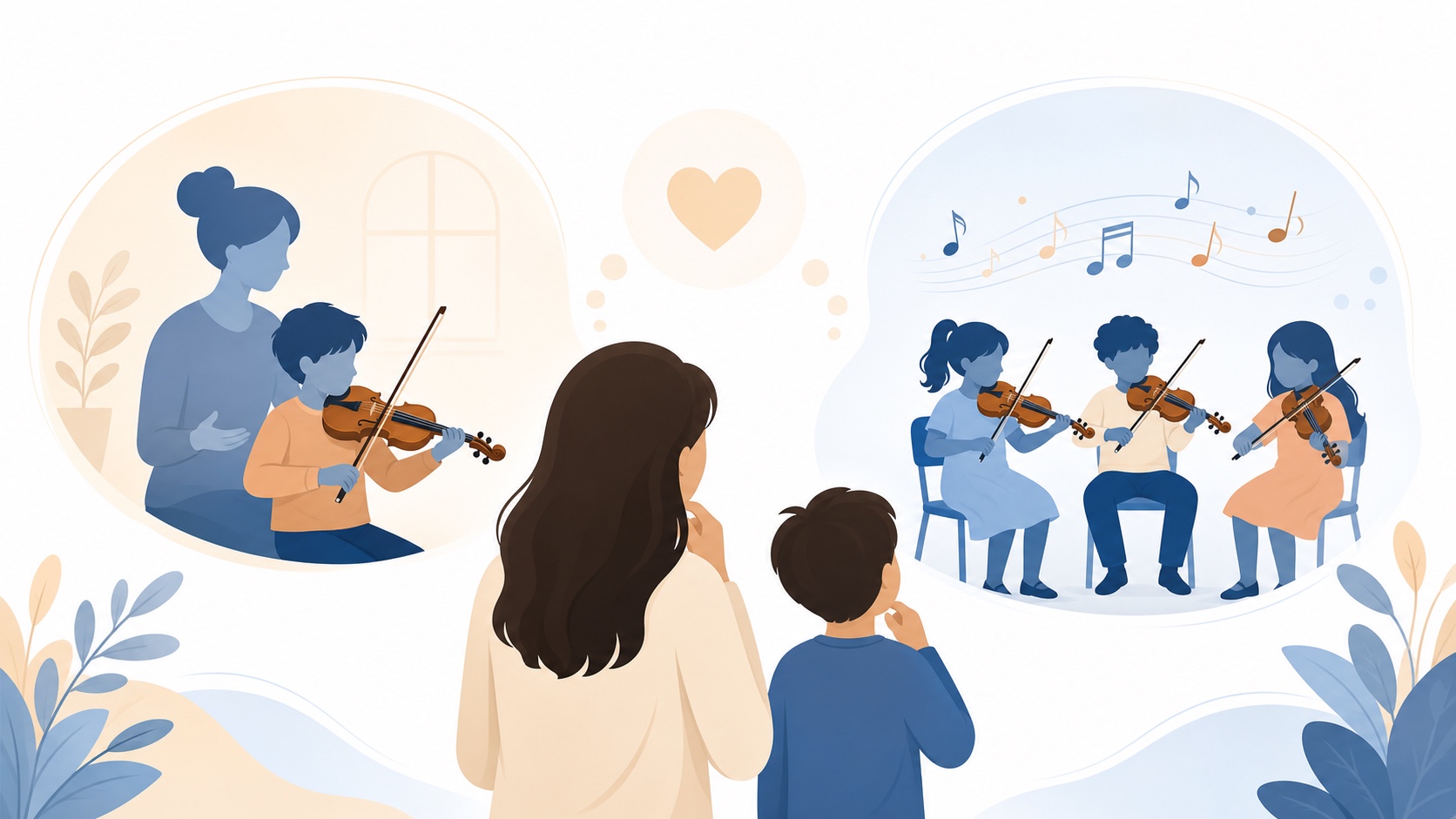
Parents ask me this more often than almost anything else at the start: should my child take private violin lessons or group classes?
My honest answer is that both can be useful. They just help in different ways, and I do not think there is one answer for every child. A child who needs a lot of correction will usually do better in private lessons first. A child who comes alive around other children may enjoy a group class more than a one-on-one lesson at the start.
If a child needs direct correction, private lessons usually give the cleanest start. If a child is motivated by other children, group lessons can be a good fit. And for some families, the best path is both, just at the right time.
I would not treat this as a competition between one format and the other. I would treat it as a fit question.
The short answer
If I had to simplify it, I would say this:
- Private lessons are usually better when a child needs close attention, clear correction, and a slower pace.
- Group lessons are often helpful when a child benefits from peers, shared rhythm, and the energy of playing with others.
- A hybrid path can work well when a child needs technical help but also likes learning in a social setting.
That is the practical answer. The harder part is knowing which one your child actually needs first.
What group violin lessons can do well
Group lessons have some real strengths. I do not dismiss them.
For some children, being with other students makes the violin feel less intimidating. They can watch, listen, and copy. That can be encouraging, especially if they are a little nervous about starting.
Group classes can help with:
- listening to other players
- taking turns
- staying with a shared pace
- learning to play alongside others
- building confidence through a social setting
That social element matters more than people sometimes admit. A child who likes being around peers may settle into a group class quickly, and sometimes that is enough to get them through the early awkward stage.
I also think group lessons can be useful for early ensemble awareness. A child begins to hear that music is not only about their own playing. They start listening for timing, matching, and blend. That is a good habit to build early.
Where group classes can be hard for beginners
Group lessons are not wrong for beginners. They just have limits.
The biggest one is individual correction. When several children are in the room, there is less time to stop on one bow hold, one shoulder, or one hand shape and fix it properly.
That matters because violin is technical from the start.
If a child is holding the bow too tightly, or twisting the left hand in a way that will cause trouble later, those habits can be missed or only partly corrected in a group.
I also see a few common problems in group settings:
- fast learners can get bored if the pace is too slow
- slower learners can feel lost if the pace moves too quickly
- shy children may not ask for help when they need it
- very eager children may move ahead before the setup is solid
So yes, a group class can be motivating. It can also leave gaps if the child needs more direct correction than the class can give.
That is not a flaw in the child. It is just a format issue.
When private violin lessons help most
Private lessons are usually strongest at the beginning, when the child is building the first habits.
Those first habits matter a lot:
- violin hold
- bow hold
- left-hand shape
- posture
- balance
- listening
- simple rhythm
If those basics are unclear, everything else becomes harder.
In a private lesson, I can see exactly what the child is doing and adjust it right away. That is the biggest advantage. There is no waiting for the next turn or hoping the issue sorts itself out in the group.
Private lessons are often a better fit when a child:
- is very young
- is shy or easily overwhelmed
- gets distracted quickly
- needs a slower pace
- needs repeated correction
- wants one-on-one attention
I also find private lessons helpful when a child is eager but a little chaotic. Some children are not resistant at all. They just move too fast. A private lesson lets me slow that energy down and keep the setup clean.
Why immediate correction matters so much
This is the part I care about most as a teacher.
If a child starts with the wrong bow hold, the wrong shoulder tension, or a strained hand position, they can build those habits without realizing it. Then those habits become normal.
That is much harder to fix later than it is to prevent now.
I would rather spend a few minutes getting the setup right than spend months untangling something that was never corrected early enough. That is true for children, and it is true for adults as well.
That is one reason I often lean toward private lessons for the first stage, especially for younger beginners.
When a hybrid path makes sense
A hybrid path can be a very sensible compromise.
For example, a child might start with private lessons to build posture, bow hold, and left-hand setup. After that, group playing can be added for social energy and ensemble experience.
Or it can go the other way around. A child may enjoy a group class first, then move into private lessons when they need more technical help.
I like hybrid paths when they are intentional. I do not like them when they are vague.
The teacher should be able to tell you why a certain order makes sense.
If the answer is simply, “more is always better,” I would ask more questions.
What I would choose for different kinds of children
Every child is different, but a few patterns come up often.
A shy child
A shy child does not automatically need a group class to become confident.
Sometimes the opposite is true. A private lesson can feel safer because the child has one adult, one conversation, and less pressure to keep up with other students.
When a shy child feels secure, confidence usually grows faster.
A distracted child
A distracted child often does better in a private lesson, at least at first.
One-on-one teaching makes it easier to keep attention on the task and gently bring the child back when their mind wanders.
In a group, distraction can spread quickly. One child looks away, another starts waiting, and the lesson loses shape.
A very social child
A social child may enjoy a group class, and that can be a good thing.
But social interest alone does not mean the group is the right first step. If the child still needs a lot of correction, the class may move too quickly for them to build good habits. I have seen that happen enough times to be careful about it.
I like to separate personality from lesson format. A child can be social and still need private lessons first.
A child who learns fast
Some children move quickly and need more challenge than a group class can give.
If they are always waiting for the rest of the class, they may lose interest. Private lessons let me keep pace with them while still checking the details that matter.
Questions I would ask before choosing a program
If you are comparing options, these are the questions I would ask:
1. Who gives individual feedback?
2. How are beginners grouped?
3. What happens if my child is faster or slower than the rest of the class?
4. Does the teacher help with bow hold, posture, and setup?
5. If my child gets stuck, how much one-on-one help do they get?
6. Is there a trial lesson so we can see how the child responds?
Those questions tell you more than the price tag alone.
Is one format cheaper than the other?
Usually, yes. Group lessons often cost less per child than private lessons.
That makes sense. The teacher’s time is being shared across several students.
But cheaper is not the same thing as better value.
If a child needs direct correction and the group class does not provide it, the lower price can be false economy. You may save money upfront and lose time later fixing habits that were never properly built. If you are comparing options, the pricing page can help you look at cost alongside lesson format and fit.
On the other hand, if a child thrives in a group and stays engaged, that lower-cost option can be very useful.
So I would not choose only on price.
What I usually suggest to parents
If your child is just starting and you want the cleanest technical foundation, I usually think private lessons are the safer first step.
If your child is already comfortable in group settings, likes music with other children, and does not need much correction yet, a group class may be fine.
If you are not sure, a trial lesson can make the decision much easier.
Sometimes the answer becomes obvious once the child is actually in the room with the instrument and the teaching style.
FAQ
Are private violin lessons better than group lessons for children?
Not always, but private lessons are often better for the first technical habits because the teacher can correct bow hold, posture, and hand position right away. Group lessons can still be helpful for motivation and listening skills.
Can my child start with group violin lessons first?
Yes. Some children do well that way, especially if they like peers and can keep up with the class pace. The main question is whether they are also getting enough correction for the basics.
Are group violin lessons cheaper than private lessons?
Usually they are. The tradeoff is that the teacher has less time for individual correction, so the lower price is not always the better value.
Can a child take both private and group violin lessons?
Yes, and that can work very well. Some children do private lessons for technique and group lessons for ensemble playing. The order should be intentional.
What is better for a shy beginner?
Often private lessons. A shy child may feel safer one-on-one before joining a group later.
How do I know which lesson format fits my child?
Ask how much individual correction your child needs, how they handle being around peers, and whether they can stay focused in a group. A free trial lesson can answer a lot of that quickly.
A calm next step
I do not think parents need to solve this perfectly before they begin.
If your child needs close correction, private lessons may be the better first step. If they love learning with other children, a group class may be a good fit. And if you want both technical help and social energy, a hybrid path may be the answer.
If you are unsure, I am happy to help you think it through. A free trial lesson is often the simplest way to see how your child responds to one-on-one teaching before you commit.
If you want to learn more about children’s violin lessons in Vancouver, or compare that choice with how to choose a violin teacher for your child, those pages may help too.