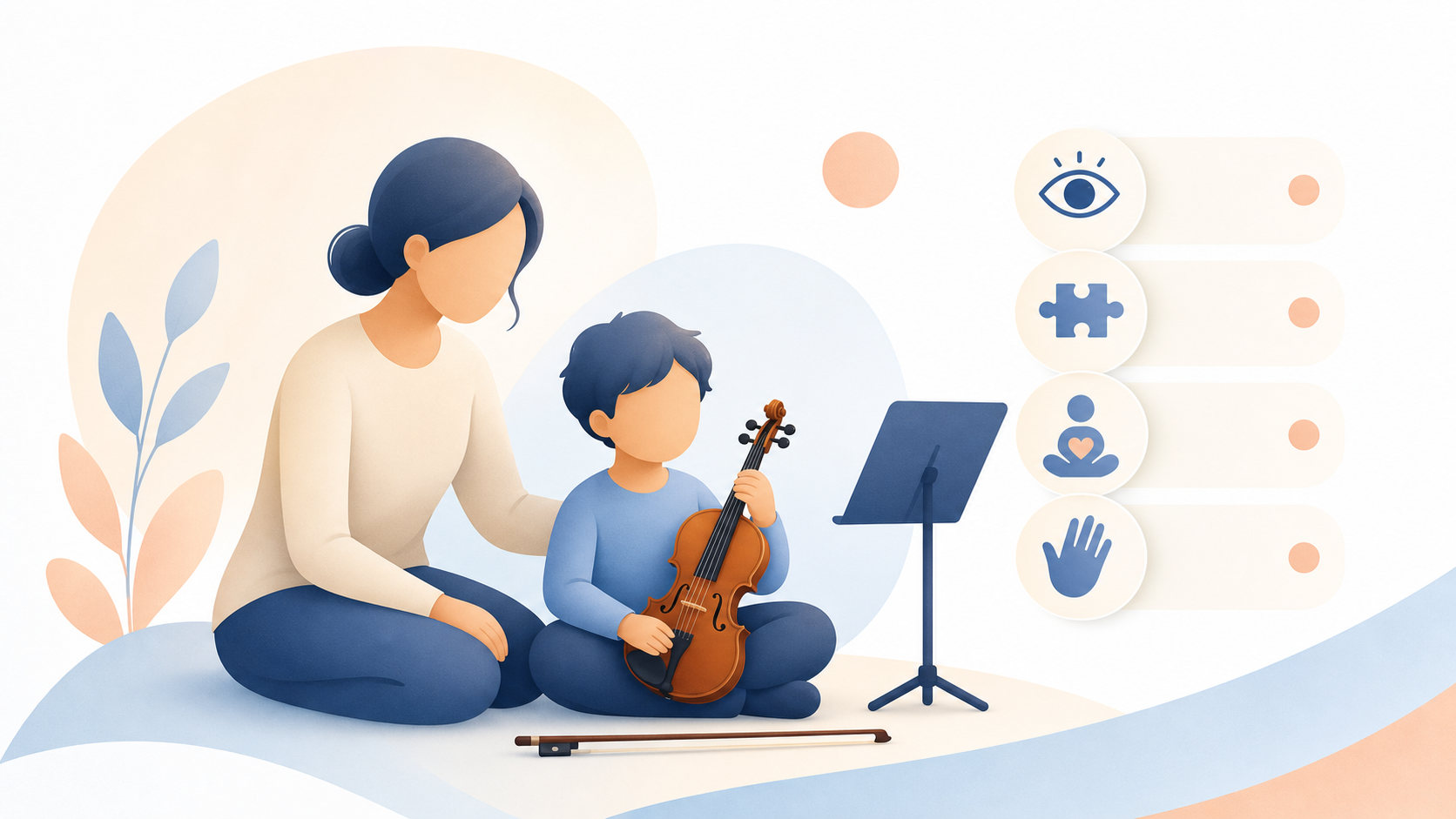
When parents ask me whether their child is ready for violin lessons, I usually say the same thing first: there is no perfect age.
That answer is not as tidy as people want, but it is the honest one. Some children are ready at 4. Some are more comfortable at 5, 6, or 7. A few are interested long before they are ready to sit through a regular lesson routine. Age matters a little. Readiness matters more.
If you are trying to decide whether to start now or wait a bit longer, I would look at a few simple signs instead of trying to guess from age alone.
There is no magic age, but there are useful signs
I do not think of readiness as one big yes or no. I think of it as a mix of smaller things.
A child may be ready when they can:
- follow a simple instruction
- stay with a short activity
- listen to gentle correction
- handle the violin without becoming overwhelmed
- accept some help from a parent at home
That is a better place to start than asking, “Is 4 too young?” or “Is 7 too late?”
Those questions sound practical, but they usually miss the real issue. The real question is whether the child can engage with the lesson in a calm, workable way.
Ages 4 to 7 are common, but readiness matters more
In my experience, many children who begin violin fall somewhere between 4 and 7 years old. That range is common, but it is not a rule, and I would not treat it like one.
Some 4-year olds are attentive and curious. They can listen, copy, and try. Others are simply better served by waiting a little while. That does not mean they are behind. It just means they may get more out of starting later.
Parents sometimes worry that waiting will close a door. Usually it does not.
If a child starts a few months later, that is not failure. It is often just better timing. A calmer start can save everyone frustration later.
Sign 1: your child can follow simple instructions
This is one of the clearest signs I look for.
Your child does not need to follow every instruction perfectly. They just need to be able to hear one idea, try it, and stay with the process long enough for the teacher to build on it.
That might look like:
- putting the violin in the right place after a demonstration
- copying a simple bow hold
- stopping when asked
- trying again after a correction
If a child cannot do this yet, lessons may still be possible, but they may need more support than they can comfortably handle right now.
Sign 2: they can focus for short, guided activities
Young children do not need adult attention spans to begin violin. They do need enough focus to follow a short sequence without drifting too far away.
A child who can sit with a picture book, a puzzle, a short drawing task, or another simple guided activity often has enough focus to begin.
What matters is not whether they can concentrate for a long time. It is whether they can come back to the task after a small amount of guidance.
I would rather see a child focus well for a few minutes than force a long session they cannot yet sustain.
Sign 3: they can handle small corrections without shutting down
This one matters more than people expect.
Violin lessons involve correction. That is normal. A child does not need to welcome correction with enthusiasm. They do need to tolerate it without feeling crushed by it.
If I show a child how to move the bow or change the hand position, I am watching to see whether they can adjust and keep going.
I pay close attention to that reaction.
Some children are naturally sensitive. That is not a problem. But if even gentle correction leads to tears, shutdown, or frustration that is hard to recover from, I would usually think carefully about timing.
Sign 4: the instrument feels physically manageable
A child should be able to manage the violin in a way that feels reasonable for their body size and strength.
That does not mean everything has to look polished. It just means the child should not seem physically overloaded before the lesson even begins.
I usually pay attention to:
- whether the violin size feels appropriate
- whether the child can hold the instrument with support
- whether the bow feels too heavy or awkward
- whether posture and balance can be coached without strain
This is one reason I like to check fit early. A child can be interested and still be too small, tense, or uncomfortable for the setup they have.
If the instrument itself is the main problem, the lesson gets harder than it needs to be.
Sign 5: a parent can support the first few weeks at home
For young beginners, parent support matters a great deal in the beginning.
That does not mean parents need to become violin teachers. They do not. It means someone at home needs to help the child remember the routine, set aside time, and keep the first few weeks steady.
The beginning often goes better when a parent can help with:
- getting the violin out and put away
- keeping practice short and regular
- listening for the teacher’s main points
- making the routine feel calm instead of rushed
If no one at home has time to support that early stage, the child may struggle even if they are otherwise ready.
When waiting is the better choice
Sometimes the kindest answer is to wait.
I would consider waiting if your child:
- cannot yet follow simple instructions for more than a moment
- becomes upset quickly when corrected
- cannot stay with a short guided activity
- seems physically uncomfortable with the instrument
- has no parent support at home during the early weeks
None of that means violin is off the table. It just means the child may get more out of starting a little later.
Parents sometimes feel they need a yes or no answer right away. Usually they do not.
Sometimes the most helpful answer is, “Not quite yet, but soon.”
When a free trial lesson helps you decide
A free trial lesson is often more useful than trying to settle everything from a checklist.
You can learn a lot by watching how your child responds to:
- the teacher
- the instrument
- simple instructions
- gentle correction
- a calm lesson environment
That short lesson can tell you more than a week of wondering at home.
It also gives you a chance to ask practical questions before you commit. If you are unsure whether your child is ready, I would rather see that uncertainty in a lesson than have you keep circling the question alone.
If your child is close but you are not sure, a trial lesson is a sensible next step.
What I tell parents when they are still on the fence
I do not expect parents to know the answer in advance.
If your child is interested, fairly calm, and able to follow a few simple directions, that may be enough to try. If they are not quite there yet, that is fine too. A few more months can make a real difference.
The goal is not to start at the earliest possible age. The goal is to start in a way that gives the child a decent chance of enjoying the process.
That usually means a lesson that feels clear, manageable, and low pressure.
FAQ
What age should a child start violin lessons?
There is no single best age. Many children begin somewhere between 4 and 7, but readiness matters more than the number. Focus, comfort, and willingness are better signs than age alone.
Can a 4-year old learn violin?
Yes, some 4-year olds can do well with violin lessons. It depends on the child’s focus, physical comfort, and ability to handle simple guidance. Some children that age are ready. Others need a little more time.
Is 7 or 8 too late to start violin?
No. That is not too late at all. In many cases, a slightly older beginner is easier to teach because they can listen longer and handle more direction.
Does my child need to read music first?
No. Most beginner violin students do not need to read music before they start. That is something they learn with the lesson itself.
Should we rent a violin before the first lesson?
Usually, yes. Renting is often the easiest way to begin because it gives you flexibility while you are still figuring out size and fit. If you are unsure, ask the teacher to check the size and setup before you buy anything.
Can online violin lessons work for young children?
They can, especially when there is good parent support at home and the child is comfortable with the format. Some children do very well online. Others need the structure of in person lessons. If you want to compare options, you can also look at online violin lessons.
A calm next step
If you are not sure whether your child is ready, I am happy to help you think it through.
A free trial lesson can show us how your child responds to the instrument, simple instructions, and a calm lesson environment. That is often the clearest way to decide whether now is the right time.
If you want to learn more about children’s violin lessons in Vancouver, or you would like to compare the teacher fit first, you can also read my guide on how to choose a violin teacher for your child.