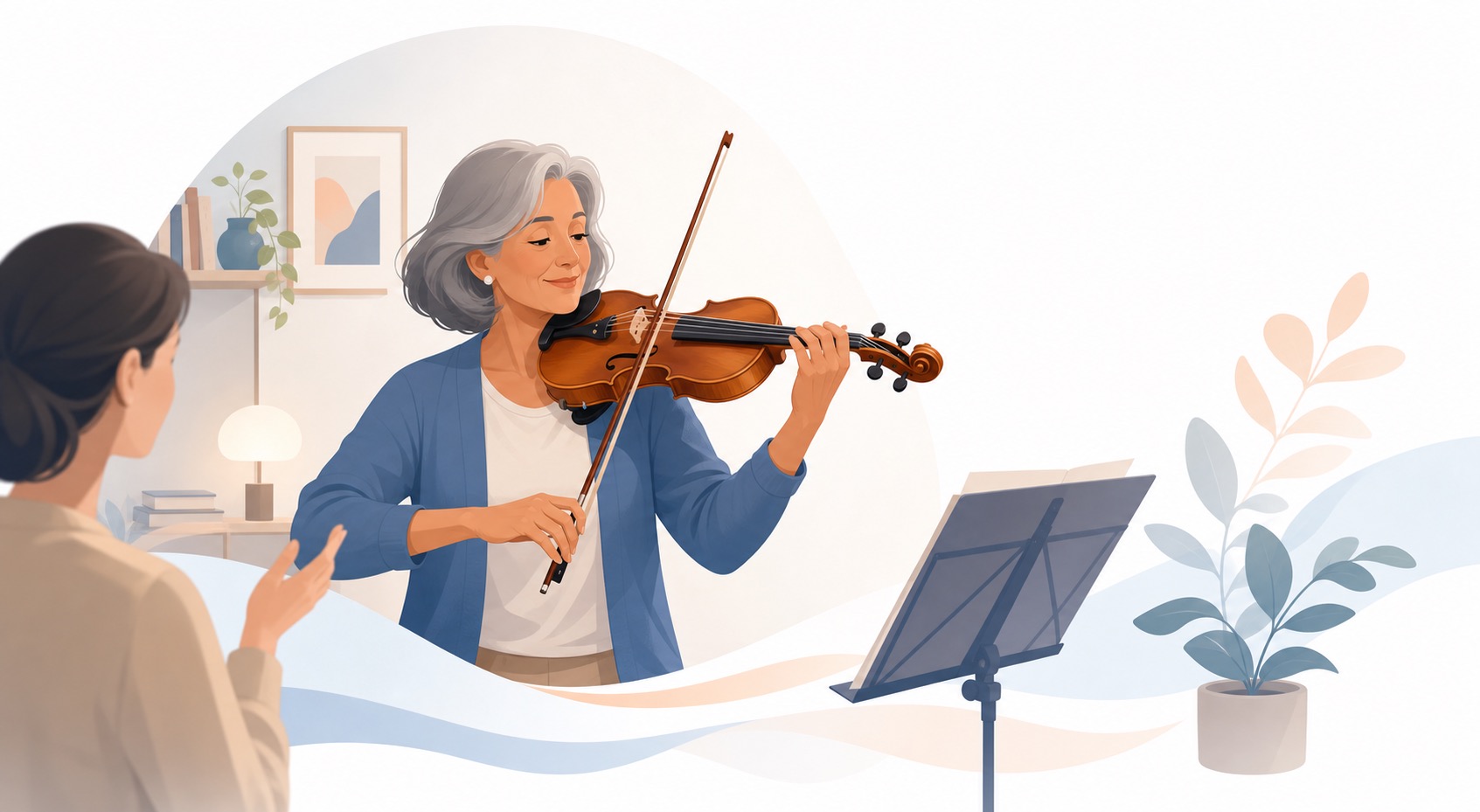
If you are asking whether you are too old to start violin, you are probably asking a few other questions too.
Will I be awkward?
Will I fall behind?
Will I need more time than I have?
Will a teacher be patient with me if I am starting late?
Those are normal questions. They are also better questions than age alone. In my experience, the real issue is not whether an adult is “too old” to begin. It is whether they have realistic expectations, a workable practice routine, and a teacher who knows how to teach adults without making the process feel confusing or childish.
So the honest answer is this: no, you are not too old to start violin. But starting well matters more than starting young.
The question behind the question
Most adults who ask this are not really asking about age. They are asking whether it is still worth beginning something difficult when they already have a full life.
That is a fair concern.
Adults usually do not have the same schedule flexibility as children. They may be balancing work, family, commuting, or a long list of other responsibilities. They may also be more self critical than children are. A missed note can feel personal. A slow week can feel like failure.
That is why adult beginner violin lessons need to be taught differently from children’s lessons. Adults do not need less honesty. They need clearer explanations, smaller steps, and a lesson structure that respects their time.
What matters more than age
Age is not the main factor I look at when starting an adult student. A few other things matter more.
Consistency
A student who practices a little bit each week usually gets farther than a student who practices intensely for one weekend and then disappears for two weeks.
That does not mean adults need long practice sessions. It means they need a repeatable routine. Ten to twenty focused minutes, done regularly, is often more useful than a perfect plan that never happens.
A realistic starting point
Adult beginners sometimes want to begin with something that feels impressive right away. I understand that. But violin is built from small technical pieces: how the instrument sits, how the bow moves, how the left hand balances, how the ear listens for tone.
If those basics are rushed, the student usually spends more time unlearning than learning.
A teacher who can explain the why
Adults often want to know why a correction matters before they fully accept it. That is not resistance. Often it is a strength.
A good teacher should be able to explain why the shoulder, wrist, bow path, or finger shape needs attention. When adults understand the reason behind an adjustment, they usually commit more willingly and practice more deliberately.
A lesson that fits real life
Adult lessons should be efficient. They should not feel like a lecture, and they should not feel like a performance review.
The best use of a lesson is to reduce confusion, correct the most important habits, and leave the student with a clear next step.
What adult beginners often do well
Adult beginners bring some real advantages to the table.
They usually:
- listen more carefully to instructions
- notice cause and effect more quickly
- understand the purpose of repetition
- can practice with more intention
- are often better at setting personal goals
Children may learn faster in some technical areas simply because they have fewer internal opinions about what learning “should” feel like. But adults often bring focus and self awareness that can make lessons productive in a different way.
That is one reason I do not think of adult beginners as “late.” I think of them as learners with different strengths.
What is genuinely harder for adults
It would be dishonest to say adult learning is exactly the same as child learning. It is not.
Adults usually face a different set of obstacles.
Limited time
This is the biggest one. Adults often want violin to fit around work and family rather than become the center of the week. That means progress has to come from efficient use of time, not from endless practice hours.
Higher self criticism
Adults are more likely to judge themselves harshly. They notice every rough sound and assume it means they are not musical.
It does not.
It usually means they are at the beginning of a technical skill. Violin makes beginners sound beginner like for a while. That is normal, not a warning sign.
Tension habits
Adults bring life habits into playing. Some hold tension in the shoulders. Some grip the bow too tightly. Some try to “help” the note by pressing too hard.
None of that means they cannot learn. It just means they need careful setup work.
Expecting results too quickly
Adults often want a clear timeline. That is understandable, but violin does not always reward that mindset.
Early progress may show up first in cleaner setup, steadier bowing, better tone, and clearer rhythm before it sounds like a polished song. Those improvements matter. They are the foundation.
Returning players are different from true beginners
Some adults asking this question are not brand new. They played years ago and are thinking about returning.
That is a different situation.
Returning students may remember note names, basic posture, or how to read music. Sometimes their hands remember more than they expect. But old habits can also come back with them. A student may remember the general shape of something while still needing to rebuild the technique underneath it.
So I treat returning adults as a fresh diagnostic case.
That means I do not assume:
- their posture is still sound
- their bow hold is still efficient
- their tuning habits are still reliable
- their ear is automatically where it used to be
At the same time, I also do not start from scratch if they clearly have a foundation. A good teacher should notice both the retained skills and the areas that need reset.
What a supportive first lesson should feel like
If you are an adult beginner, your first lesson should not feel like being dropped into the deep end.
It should feel clear.
A supportive first adult lesson usually includes:
- a quick conversation about goals and schedule
- instrument setup and posture checks
- simple bow hold or left hand basics
- one or two manageable exercises
- a practical explanation of what to practice at home
You should leave with more clarity than you arrived with.
You should not leave feeling overloaded with ten corrections and no sense of priority.
Adults often do best when the teacher narrows the focus. The goal is not to prove how much you can absorb in one lesson. The goal is to build a repeatable path forward.
What progress can realistically look like
One of the biggest mistakes adult beginners make is comparing their beginning to someone else’s middle.
That comparison is unfair and not useful.
Realistic early progress might look like:
- holding the violin more comfortably
- producing a steadier sound
- finding a more balanced bow hold
- learning a few notes cleanly
- keeping a simple rhythm steady
- understanding what to practice between lessons
Those are meaningful wins.
They are not flashy, but they are the kind of progress that leads to durable playing later.
Over the first few months, many adult students notice that the instrument feels less strange, the bow feels less unpredictable, and basic reading starts to become more familiar. That is already real learning.
Mastery takes longer. But beginners do not need mastery to justify starting.
How much practice do adults really need?
This question comes up often, and the answer is usually less dramatic than people expect.
You do not need hours every day to make progress as an adult beginner.
You do need regular contact with the instrument. The exact amount depends on your goals and your schedule, but short consistent sessions are usually better than occasional long ones.
What matters most is that practice is:
- specific
- repeatable
- realistic
- tied to what your teacher assigned
If you only have a small window each day, that is still useful. Adults often improve faster when they stop waiting for the perfect practice schedule and start using the schedule they actually have.
Is private instruction still worth it for adults?
Often, yes.
Adult beginners usually benefit from private adult violin lessons because they need direct feedback and efficient use of time. A private teacher can adjust pacing, correct habits early, and tailor the lesson to the student’s goals.
That is especially helpful if you are:
- starting from scratch
- returning after a long break
- unsure what a good practice routine should look like
- trying to fit lessons into a busy week
If you are comparing lesson options, private instruction can make the beginning feel less scattered. It gives you a place to ask practical questions and get immediate correction before habits settle in.
If your schedule is tight, online violin lessons can also be a good fit for some adults. The format matters less than whether the lesson is well structured and the teacher is able to give useful feedback. If you want to compare options first, pricing details and the guide to what violin lessons usually cost around Vancouver can help you decide what lesson format fits your schedule and goals.
What I tell adult beginners who feel embarrassed
Many adults are not afraid of the violin itself. They are afraid of feeling behind.
That feeling is more common than people admit.
Here is the part I think matters most: being a beginner is not a character flaw. It is a stage. Every violinist was there.
Adults sometimes think they should arrive already knowing how to do everything cleanly. But the whole point of lessons is to learn. If you could already do it alone, you would not need a teacher.
The right teacher should make room for imperfect beginnings. Adults do not need to be treated like children, but they also do not need to be ashamed for learning something new.
When starting violin as an adult is a good idea
Starting violin as an adult is often a good idea if you want:
- a structured personal challenge
- a creative outlet with clear feedback
- a teacher who can adapt lessons to your pace
- a realistic learning process rather than instant results
- a way to return to music in a low pressure setting
The question is not whether you are still young enough.
The question is whether you are willing to start in a sensible way.
If yes, then you are a legitimate beginner, not an exception that has missed the chance.
FAQ
Am I too old to learn violin as an adult?
No. Adults can absolutely learn violin. The main difference is that adults usually need realistic practice expectations, clearer feedback, and patience with the early technical stages.
Can adults learn violin from scratch?
Yes. A complete beginner can start from zero at almost any adult age. Progress depends more on consistency, lesson quality, and follow through than on being young.
Is it harder to learn violin as an adult than as a child?
In some ways, yes. Adults often have less time and more self criticism. In other ways, adults can learn faster because they usually understand instructions more clearly and practice more intentionally.
How long does it take an adult beginner to learn violin?
That depends on what “learn” means. Early comfort, basic tone, and simple pieces may come with steady work over the first months. Long term fluency takes much longer. A good teacher should help you set milestones that make sense for your goals.
Can I restart violin if I played years ago?
Yes. Returning players often have useful memory and musical awareness, but they may also need to rebuild technique. A good lesson should assess both what is still there and what needs to be reset.
What should I expect in my first adult violin lesson?
You should expect a clear setup check, some basic playing or posture work, and a practical practice plan. The best first lesson leaves you with clarity, not overload.
A sensible next step
If you have been wondering whether you are too old to start violin, the short answer is no.
The more useful question is whether you have a teacher who can make the first steps clear, manageable, and honest. That is what helps adult beginners stay with it.
If you are ready to explore violin lessons, book a free trial lesson or get in touch to ask a question before you commit.